


Changes are coming to Quincy Street NE, but its future is still leading to disagreement.
At an April 8 open house at the Northeast Park Recreation Center, Minneapolis representatives presented their final proposal for a significant renovation of a three-block stretch of Quincy Street, from Broadway to 15th Avenue NE.
The City is planning a redesign of several North-South streets above Broadway as part of the Logan Park Industrial Neighborhood Street Reconstruction project. The plan involving Quincy Street will include many changes, including the addition of concrete sidewalks and curbs, trees, grassy boulevards and parking on both sides of the street.
The meeting drew dozens of interested people from the neighborhood, along with Public Works representatives. Public Works Senior Transportation Planner Katie White said that no construction work on the street will take place before at least 2027.
Quincy Street has distinct features and a long history. The street was developed around 1912 as a passageway for manufacturing plants in that area. Since the buildings on the street and the North end are blocked by rail lines, the street is about three blocks long, and its 50-foot width is narrower than adjoining streets, likely because it was intended for truck delivery and as a railroad stop rather than as a thoroughfare.
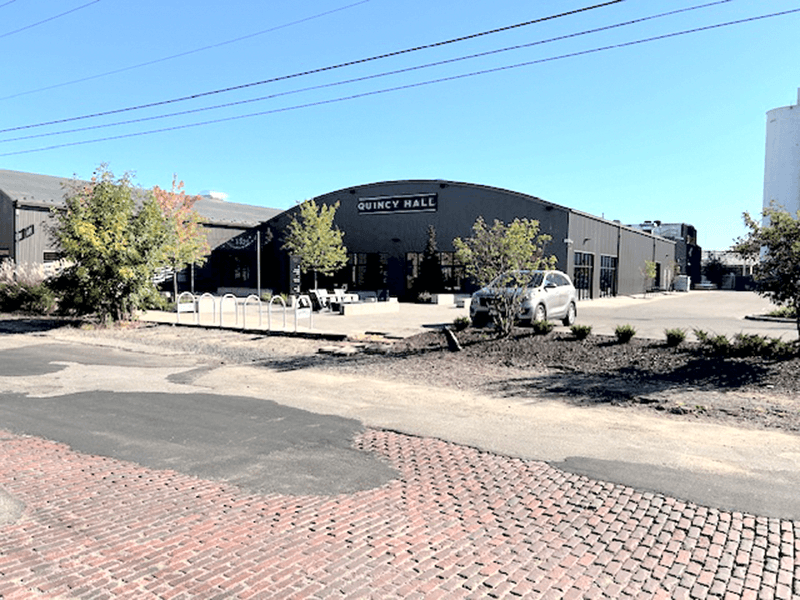
The street itself was paved with Purlington bricks, a common choice during that period. Several adjoining streets were brick but have since been paved over with asphalt. Quincy is one of the few remaining areas with their original brick paving. The street is defined, in part, by its lack of curbs and conventional sidewalks. The city wants to address this in their changes.
Over the years, virtually all manufacturing has left the area, leaving the buildings, bricks, smaller businesses and, later, artists. In the three decades since the advent of Art-A-Whirl, the street has become an evening and weekend hub for visitors, with restaurants and access to artists’ studios.
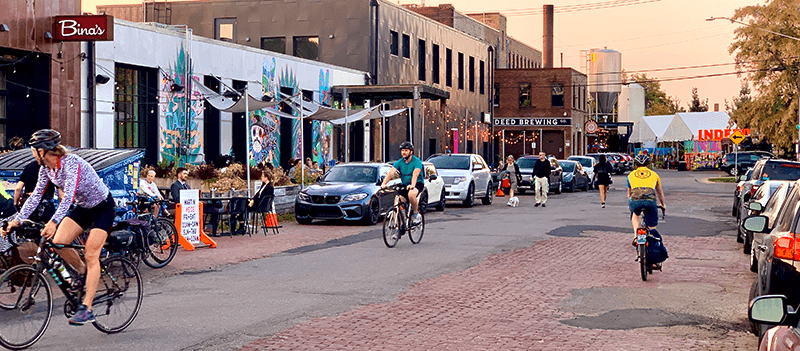
Above shows how the street is used by cars, pedestrian and cyclists. (Seth Stattmiller) Below shows how the street has become hard to traverse with crumbling bricks, potholes and inconsistent repaving. Various interest groups have differing hopes for the street’s future. (Josh Blanc)
Recovery Bike Shop owner Seth Stattmiller said the street has almost no pedestrian infrastructure, so people simply walk in the street, where the red bricks and potholes encourage motorists to drive a bit slower.
Stattmiller said the road has helped foster a vibrant, activated commercial district with thriving businesses. The area, he said, has become the heart of Art-A-Whirl. He called it one of the few commercial spaces in Minneapolis where it feels safe to be a pedestrian.
Josh Blanc is a Northeast tile artist, co-owner of Clay Squared to Infinity since 1996, and a co-owner of Flux Arts Building since 2018. He’s also chair of the Northeast Minneapolis Arts District, and writes for the Northeaster newspaper about artists and their experiences in the Arts District. He is an outspoken critic of the City’s plans for the street.
He noted that part of the Northeast Minneapolis Arts District mission is to defend the district from “ill-advised development. Therefore, we are the organization that addresses the unique challenges faced by artists and the art buildings.”
Asked about positive and negative results of the level of changes suggested by the plans, Blanc said he believes the Arts District and businesses on Quincy Street have pushed the City to rethink its planning.
“The City has resisted at every stage,” Blanc said. “Offering excuses like snowplow usage and safer streets. Currently, this is one of the safest streets in the city. Delaying them has been our most positive feature while we develop our own shared street proposal.”
He added that neighborhood resistance should result in the project’s stoppage, at least until the city can hire urban planners to bring their expertise to bear.
The negative results, in Blanc’s eyes, include the street becoming “car-centric” by separating cars from bikes and walkers with sidewalks, making it likely that cars will drive faster and cause more accidents. He said that the City’s current designs “detract from the organic, shared street that has made it so successful. There is no reason to spend millions of dollars changing one of Minneapolis’ most successful comeback streets, which features hundreds of artists, entrepreneurs, businesses, restaurants and community and art gatherings.”
Blanc added that he hopes the Public Works Department will listen to stakeholders and develop a plan that focuses on fixing the underground water filtration and reusing the brick pavers.
He also wants the Department to work on improving ADA compliance, keeping parking spaces for the businesses that depend on them — all “without curbs.”
According to reporting by the Star Tribune, Jonathan Query, who owns two buildings on the street, said artists need to be able to park in front of their buildings so they can load materials. Query and other attendees said if artists cannot control their parking location, they may have to carry materials from blocks away. Artists said this could lead to their business’ closure.
Third Ward City Council Member Michael Rainville said there’s no other city street as “alive” as Quincy Street, with its diverse businesses and a unique street design. He referred to it as a “jewel of the Arts District.”
Rainville said he applauds Blanc and Stattmiller’s efforts to push City staff to reconsider. “The feedback I have gotten from constituents is overwhelmingly in favor of a better design than the current ones offered,” he said.
The Quincy Street renewal plan also includes bicycle accommodations, pavement, curb and gutter improvements, utility updates and pedestrian ramps that comply with the Americans with Disabilities Act.
Last May, the Logan Park Neighborhood Association provided a letter of support for the Logan Park Industrial Neighborhood Street Reconstruction project, which they submitted with their application to the City’s Public Art Team. The Association hopes to integrate art into the City’s planning for the Logan Park Industrial area.
About the street’s future, Blanc said, “If they turn this street into a typical Minneapolis street rather than the destination area it already is, it will most likely attract Fortune 500 companies like Starbucks and tech startups — groups that can smell money and drive the creatives away.
“Northeast is comprised of small businesses, and Quincy Street and Logan Park Industrial are amazing incubators for these entrepreneurs. The city should work to ensure its success, not tax them out of existence with expensive road construction for something they don’t want.”