


The 32nd International Sculpture Conference (ISC), coming to the Twin Cities Oct. 22-26, has prompted members of the Arts District to talk with major players in the sculpture community about their vision for public art in the future.
John Hock and Alyssa Baguss, two Northeast artists, expressed desires to get art out in the community for public engagement. Both said they had experienced challenges working with the Minneapolis Arts and Culture Public Art department, saying they struggled to get public art on public lands.
Instead, Hock and Baguss have focused on private land and working with patrons to showcase sculpture and bring art to the public.
The International Sculpture Conference is an opportunity for sculpture enthusiasts to take in the Twin Cities’ sculpture scene. It lets attendees engage with the public art they pass by daily, getting a better understanding of how it brings ideas, landmarks and beauty to the city.

John Hock, art director of NE Sculpture | Gallery Factory, 1720 Madison St. NE #14. (Josh Blanc)
NE Sculpture | Gallery Factory
Over the years, John Hock has created an atmosphere where cultures mix with creative wit, energy and artistic expression at the center of NE Sculpture | Gallery Factory, 1720 Madison St. NE.
John was interviewed after the Aug. 13 Serpentine Arts event, “Meximalismo,” which included an exhibition and fashion show. More than 200 people attended the exhibition and fashion spectacle. Asked how he works with artists from a wide range of cultures, Hock said, “Sculpture has been (my) whole life since I was 20.” Travelling and meeting artists from all over the world has given him a large pool of potential collaborators.
Under his direction, the Sculpture Gallery has expanded from sculpture to painting, mixed media, video, photography and fashion shows.
The Gallery’s projects expand beyond its walls. Shortly after the murder of George Floyd in 2020, Hock started working with Peyton Scott Russell, a Minneapolis artist who created a mural honoring Floyd. Ultimately, they secured a set of billboards in George Floyd Square, at the corner of 38th and Chicago Avenue S.
Hock said, “I was able to secure the three billboards that face into the square from Clear Channel Outdoor.”
Hock said he reached out to New York artist Dred Scott to make and curate suggested artists to create works for the billboards. Scott, in turn, recommended the NE Sculpture Gallery to the National Academy of Design/Edwin Austin Abbey Memorial Trust Fund for Mural Painting, where the gallery secured funding for 24 months.
Hock said, “We change the boards usually around every three months with 12 different artists’ works throughout the year. Thirty-four artists have shown since 2020. Some artists have done more than one board.”
Artists around the country have created art projects with billboards. The George Floyd Square project differs. It’s a multi-year effort that lets artists of color create public art without editing by committees or government. The billboards were present during Operation Metro Surge. This project continues today, offering unfiltered public art to the individuals visiting George Floyd Square.
The ISC Gallery will bus conference attendees to NE Sculpture I Gallery Factory on Sunday, Oct. 25, 1:30-6 pm. Hock called it “a kind of mini Art-A-Whirl.” There will be music, stone carving, art cars, a bonfire, the WOW Bus, a sculpture exhibition inside and out called “Proof of Life,” a sculpture show, videos and a food truck. Minneapolis sculptor Andrew MacGuffie is working on an immersive community arts sculpture in the Sculpture Quad. Hock said about 25 local artists will exhibit, in addition to works from artists from around the country.
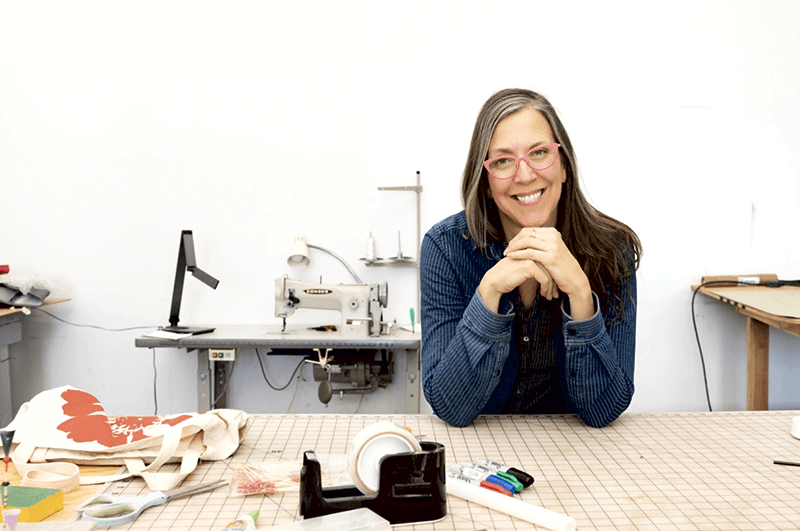
Alyssa Baguss in her studio at the California Building, 2205 California St. NE. (Lisa Roy)
Silverwood Sculpture Park
For artist and Silverwood Park Director Alyssa Baguss, the International Sculpture Conference is an opportunity to celebrate what has been built over the past 17 years and to ask what the future of sculpture in the Twin Cities might look like.
Baguss is a practicing artist with a studio in the California Building. She has more than 20 years of experience exhibiting regionally and nationally. A McKnight Fellow for Community Engaged Artists, she is also unique within Three Rivers Park District as an artist leading one of its parks, bringing an artist’s perspective to the leadership and development of a large public institution. She came to Silverwood with a background in arts integration, using creative practice to connect people with science, nature and other subjects. When Silverwood opened 17 years ago, she was hired to build its arts program from the ground up.
“There was no curriculum, hardly any sculpture and not even furniture,” Baguss said. “It was essentially a startup, and we had the opportunity to ask what a nature inspired arts park could be.”
Silverwood sits on 120 acres in St. Anthony that served for nearly a century as a Salvation Army youth camp, bringing children from the city into the outdoors. Sculpture became an important part of the park’s new identity. What began with one or two works has grown into 17 sculptures dispersed throughout the landscape.
“I think of them almost like breadcrumbs,” Baguss said. “They draw people through the park and signal that art is part of this place.”
Being in Three Rivers Park District also gives artists access to expertise rarely found inside a traditional gallery. For “The Bio Scenic Machine Cyto Squad,” Sara Hanson created an interactive kaleidoscopic sculpture using specimens collected at Silverwood and identified with environmental educators. For “Decline and Fall,” Marjorie Fedyszyn collaborated with forestry, natural resources and invasive species specialists to transform a fallen ash tree from Silverwood into a suspended installation responding to the emerald ash borer, an invasive beetle that kills ash trees in North America.
While at Silverwood, Baguss hopes ISC visitors will notice a model where artists can engage with environmental professionals, natural systems and a public that may not have arrived looking for art.
Nearly half a million people visit Silverwood each year. Alongside more than 700 annual programs, exhibitions, concerts and participatory experiences, visitors walk, bike, paddle, fish, drink coffee or simply spend time outside. Art becomes part of everyday experience.
“It shouldn’t be a privilege to see art,” Baguss said. “It should be part of our everyday lives.”
Looking ahead, Baguss is also thinking about who will make the next generation of outdoor sculpture. Minnesota has a rich arts funding ecosystem, including Minneapolis Arts & Cultural Affairs, the Minnesota State Arts Board, Regional Arts Councils and other opportunities.
These resources provide critical support, but funding structures also influence what gets proposed and who has the resources to make it. Sculpture presents particular barriers, including costly materials, specialized equipment, fabrication and engineering knowledge, transportation and space to work at scale.
“I keep wondering who is making sculpture next, and what they need from us to make that possible,” Baguss said.
That’s what makes hosting ISC meaningful to Baguss. When conference attendees visit Silverwood in October, they will explore the sculpture trail and gallery, experience the park’s natural landscape and hear directly from Fedyszyn about the interdisciplinary process behind “Decline and Fall.” Participants will also try paper casting, one of the processes Fedyszyn used in the work.
Baguss hopes visitors leave interested not only in the sculptures they encounter, but in Silverwood itself as a model: a place where artists, environmental professionals and the public can learn from one another, and where sculpture is not separated from everyday life but embedded within it.