Students and faculty at Saint John Paul II Catholic Preparatory School were anxiously awaiting the arrival of Archbishop Bernard Hebda February 9. Signs welcoming the archbishop peppered the hallways as some students and teachers peeked outside the classrooms to catch a glimpse.
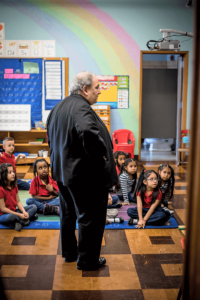
Archbishop Hebda arrived about an hour before the 3 p.m. mass he would lead at Holy Cross Church. He was greeted by Father Kevin Finnegan as well as some administrative staff including Principal Señor Edgar Alfonzo and Alison Simons James (Lead Gift Officer). His first stop was a kindergarten classroom. The five- and six-year-old students sat excitedly on the rug and welcomed Archbishop Hebda into their classroom. He gleefully spoke with the students about what they were learning and what they enjoyed about their school. The students read, and sang a song. As he said goodbye to them in the doorway a young girl ran up and gave him a hug. That prompted a few other students to do the same before the faculty team told the class he was on a tight schedule and had to move along to the next class.
The archbishop’s next stop was upstairs to a classroom of both 7th and 8th grade students. He began by asking the class to “Name one thing that you can think of that you like here?” “Everyone’s really nice” said one student. Another girl replied “I like how everyone here is like a community…we’re all like a family.”
“How wonderful is that?” replied Archbishop Hebda. He asked the students what difficulties they face, which subjects they enjoy, and asked a show of hands of how many students enjoyed religion class (which was followed by laughter).
“I’ve heard such great things about you,” said Archbishop Hebda. “Any questions you have for me?” Father Finnegan began a string of “either/or” questions to get things warmed up, including “Pepsi or Coke, coffee or tea, books or movies?” When the questions came to food; Chinese, Italian or Mexican—to which the Archbishop said Italian. “You know, I lived in Italy!”
Archbishop Hebda laughed and joked with the 7th and 8th grade students as if he had known them the entire school year, fading away the anxiety of having such a prominent Catholic Church figure in their room. Students asked, “What’s the pope like?” “I’ve only met the pope four or five times,” replied Archbishop Hebda nonchalantly, to some giggles. “He’s very warm. He makes you laugh, you feel at ease. They’ve been short meetings,” though in one of his longer meetings with the pope he regarded the pontiff as being very understanding of problems very quickly and always proposing good, positive responses. The archbishop, like his description of the pope, was also warm and inviting, genuinely happy to be talking with the students, welcoming their questions.
Archbishop Hebda asked the classroom how many were born in Minneapolis. Many raised their hands. When he asked if anyone was born somewhere warm a few hands in the room shot up. “Las Vegas” replied a young lady, “Ethiopia” replied another student. “Spain” said another proudly.
“What an international classroom!” said the archbishop with awe. “(Ethiopian food) is really good. You know that big pancake thing…I love it. It can be a little bit spicy, too. Ethiopian food is great, Spanish food is wonderful and in Las Vegas you just play games,” joked Archbishop Hebda.
After the laughs, looking on at the very diverse room of students, Father Finnegan provoked a more serious question to the archbishop. “There’s a lot of conversation about who we are nationally and internationally and so things like immigration have come to the forefront. Some of us are immigrants and we recently had a pro life march in Washington. We’re wondering if you could address immigration and the pro life movement.
“From our Catholic teachings and our faith and our world view one of the things that’s most important is the dignity of each human life…If we’re created in God’s image and likeness, then there has to be good in all of us from the moment we’re created. The first moment of conception we already have a dignity because we’re created in the image and likeness of God. We want to really respect life at every stage, not just a born life but even at the end of life when a person is old and sickly. That’s really fundamental for me and our church.”
From that Archbishop Hebda transitioned to immigration. “It’s that same respect for human life that causes our church also to really be concerned about immigrants and refugees. We want to make sure that people are treated with respect whether or not they have documents. We also feel strongly about the family. So often our laws keep apart families. Part of family in one country and part in another. They want to be reunited. So we’re really interested in doing anything we can to keep families together. So on those issues I think the church is pretty strong and it’s pretty consistent.”
Quietness filled the room as the archbishop asked the students their thoughts on the two subjects of pro life and how the church could be better about reaching out to immigrants. The students’ eagerness to speak and the laughter had turned to a more serious tone.
“What do you think? Should we let more people into our country? Should we be concerned about that?” Still no replies. “Anybody going to go volunteer to build that wall between the United States and Mexico?” asked Hebda. No hands went up.
“Here we are in Northeast (Minneapolis)—what a great place! I looked out and saw this great church behind us [the Russian Orthodox Church]. So this is a place where you had people coming from all over. That’s part of our tradition is welcoming people from all over the world. So in my last diocese in New Jersey and I looked at the rear-end of the Statue of Liberty every day.” said Archbishop Hebda, lightening the mood again as students chuckled. “First I wasn’t so happy because all the people in New York get to see the front. But I like the fact that we had the back of Lady Liberty. That we’re her support. And there she was in New York Harbor welcoming all of the huddled masses…anybody that was looking for a home. It’s part of our history so we want to make sure that we continue that. We obviously want to make sure we have a secure country, but we can do both,” he assured them.
After a few more questions, Archbishop Hebda bid the classroom farewell and was escorted to mass, making some unexpected brief stops in two other classrooms along the way. To this observer, his ability to ease the fears and anxieties of the many students, many of different ethnic backgrounds, left a sense of comfort and hope for the future of this country.
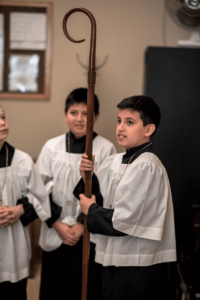
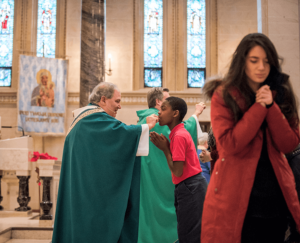
Below: Archbishop Bernard Hebda visited the school and then led mass at Holy Cross Feb. 9. (Photos by Mike Madison)